
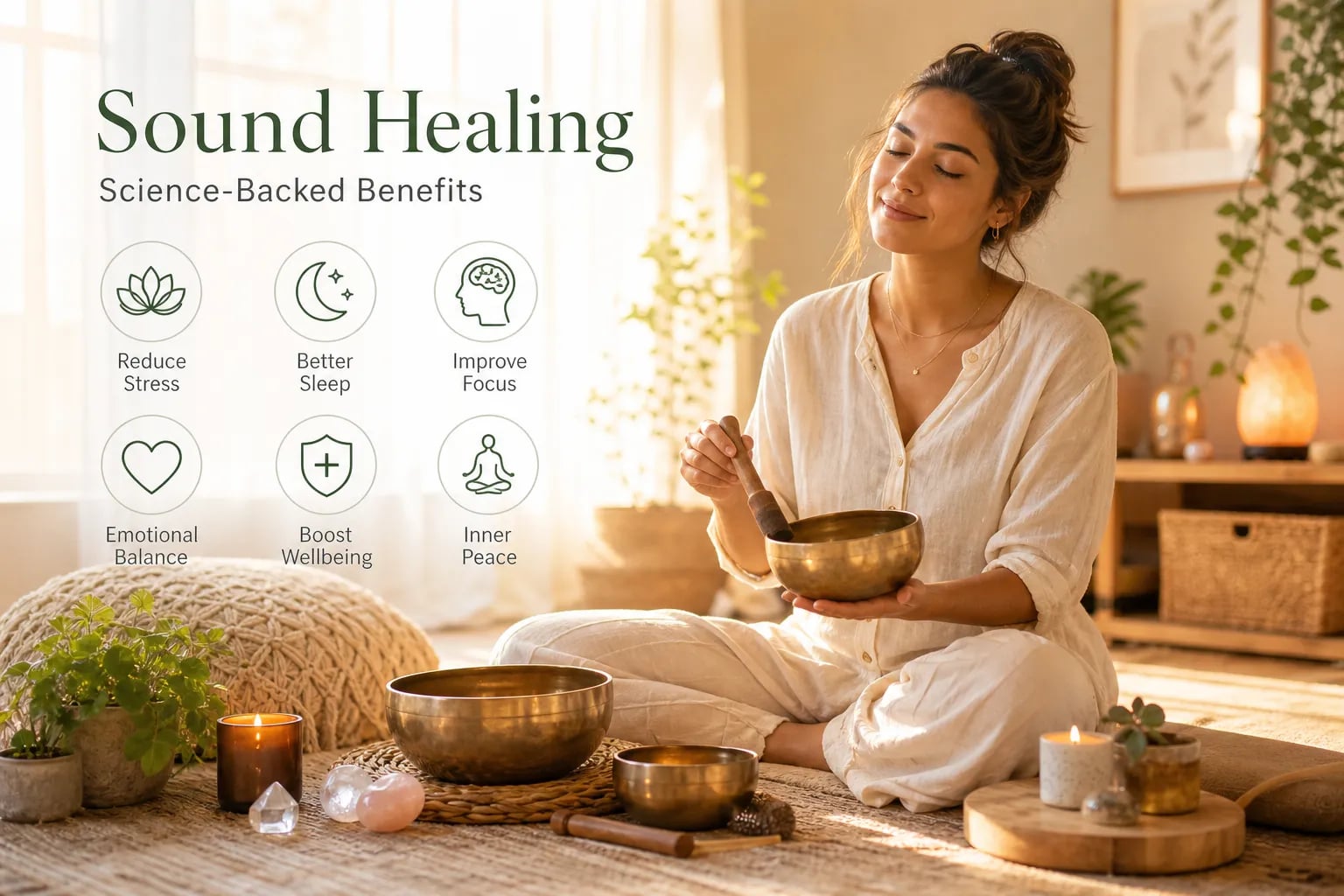
Close your eyes for a moment and imagine this: a sustained, warm hum fills your hotel room as the Riviera Maya breeze moves through half-open curtains. A Tibetan singing bowl is still vibrating, its tone settling into the air like something your nervous system has been waiting for. You haven’t moved, haven’t spoken, haven’t done anything except breathe. And yet something in your body has already shifted.
Most people encounter sound therapy, known in Spanish as sonoterapia, for the first time in exactly this kind of setting, somewhere the pace has slowed enough to notice the difference. The real question is whether what they feel during a session is measurable, repeatable, and grounded in science. For certain outcomes, particularly sleep quality and anxiety reduction, the answer is a clear yes; for others, the evidence is promising but still accumulating. Travelers staying in the Riviera Maya increasingly book professional vibrational sound therapy sessions through services like Spa at Home Playa del Carmen, bringing the full treatment directly to their room or suite. This article is a science-first look at what those sessions actually do to your body, the seven core sonoterapia beneficios that research supports most strongly.
What sound therapy is and what a session actually looks like
The instruments: singing bowls, gongs, and tuning forks
Sound therapy uses specific instruments to produce sustained tones and vibrations that interact with the nervous system. Tibetan singing bowls are metal alloy bowls with rich, layered overtones. Crystal singing bowls, made from quartz, generate purer and more sustained tones that project further into a room. Gongs produce deep, full-body vibration with an intense wash of sound that practitioners typically use at the resonance peak of a session. Tuning forks are precision tools used for localized frequency work rather than a full soundscape. Each serves a different purpose, and a skilled therapist selects instruments based on the session’s goal.
The distinction between Tibetan and crystal bowls matters in practice. Tibetan bowls are consistently described as grounding and intimate, well-suited to close-up, body-based work. Crystal bowls are more expansive and resonance-focused, often preferred for group sound baths. No clinical evidence shows one outperforms the other, but both have distinct acoustic profiles that shape the quality of the experience.
What happens during a sound bath
A typical sound bath session has the client lying still in a comfortable position, either on a mat or on a bed, while the practitioner moves through a deliberate sequence of instruments. Full sessions run between 45 and 90 minutes. A well-structured sound bath has three phases: an opening that introduces the body to sound, a sustained resonance peak where the nervous system shifts most noticeably, and a gradual close that allows a soft return to full awareness. The goal is passive immersion, not active participation. Your only job is to stay still and breathe.
How sound therapy works inside your body (sonoterapia beneficios: the physiology)
The vagus nerve, autonomic balance, and HRV
Auditory input connects to brain networks that regulate autonomic and stress responses. When calming sound activates parasympathetic pathways, heart rate slows, breathing deepens, and heart rate variability (HRV) increases. One study reported that sound stimulation improved autonomic stability by stimulating the vagus nerve, with measurable increases in SDNN and RMSSD, two key HRV indices that reflect the body’s recovery capacity. Higher HRV is consistently associated with better stress resilience and cardiovascular health.
These effects happen fast. Research shows that sound can modulate autonomic responses through brainstem and limbic pathways within minutes of exposure, an effect that parallels the speed of other direct sensory inputs such as touch or changes in temperature.
What happens to cortisol during sound sessions
Cortisol is the primary stress hormone, and it’s one of the most studied biomarkers in sound therapy research. A 2025 systematic review found that sound interventions can significantly regulate cortisol levels, with the strongest evidence pointing to self-selected, relaxing music rather than non-music sound modalities. The effect operates through the hypothalamic-pituitary-adrenal axis: calming sound dampens the stress signal before it reaches hormone production. The important caveat is that effects are stronger when the sound is genuinely relaxing to the listener, which is why session quality and setting matter as much as the instrument itself.
The physiological benefits: stress, sleep, anxiety, and pain (sonoterapia beneficios 1, 4)
1. Measurable stress reduction
The 2025 systematic review confirmed that self-selected relaxing music and structured sound interventions reduce physiological stress markers, including cortisol, blood pressure, and disrupted HRV. Structured sessions produce more consistent results than passive ambient noise, which suggests that session design matters. For travelers with accumulated tension from long flights and packed schedules, even a single well-run session can produce measurable physiological effects.
2. Anxiety relief with clinical backing
A 2013 Cochrane review of 26 studies in surgical patients found that recorded music significantly reduced preoperative anxiety, one of the most demanding anxiety contexts that exists. A 2020 systematic review confirmed that sound-based treatments reduced both somatic and cognitive state anxiety. Effects were strongest in people with moderate baseline anxiety, which describes a large portion of vacation travelers who arrive carrying stress from work, travel logistics, and overstimulation.
3. Improved sleep quality and faster sleep onset
This is where the evidence is most robust. A 2025 meta-analysis of acoustic stimulation reported an overall mean difference of -2.68 on insomnia outcomes, with statistically significant improvements in sleep quality, insomnia severity, and sleep onset latency. A separate experimental study found that broadband sound reduced time to sleep onset by 38 percent, cutting the median time from 19 minutes to 13 minutes before reaching stage 2 sleep. For travelers dealing with jet lag or the mental overactivity that comes with new environments, this is one of the most practical and immediately felt applications of sound therapy.
4. Pain reduction and emotional distress from pain
A 2017 meta-analysis of 14 randomized trials in people with chronic pain found reductions in self-reported pain intensity and in depressive symptoms linked to pain. It’s worth noting that this body of evidence is less consistent than the sleep literature, results varied by condition and intervention type. Greater benefit was reported when participants chose the music themselves, reinforcing the role of personal resonance in how sound affects the nervous system. While singing bowl studies are smaller in scale, the underlying mechanism of parasympathetic activation and reduced pain perception runs through the broader sound and music therapy literature.
The experiential benefits: mood, clarity, and internal reset (sonoterapia beneficios 5, 7)
5. Elevated mood and reduced depressive symptoms
Research on sound therapy and mood draws from both clinical music therapy literature and emerging singing bowl studies. A 2025 review referenced in Cedars-Sinai’s wellness content found that singing bowl therapy may reduce depression scores alongside anxiety. The likely mechanism involves shifts in autonomic tone and the emotional processing that occurs during deep relaxation, when the brain naturally moves toward slower brainwave states. Some studies link increased theta-range brainwave activity during sessions with subjective emotional processing, though results in this area are still inconsistent and warrant further research.
6. Improved mental clarity and attention restoration
Sound baths shift brainwave activity toward alpha and theta states, which are associated with relaxed alertness, creativity, and reduced mental noise. Alpha waves increase when sound promotes relaxation without inducing sleep; theta activity rises during deeper meditative listening. Participants commonly report feeling sharper and more focused after sessions, a subjective effect that parallels attention restoration research, though controlled trials specifically measuring post-session cognitive performance remain limited. For digital nomads and overworked travelers, this is often the least expected but most valued outcome of a session.
7. Energetic balance and a sense of internal reset
This benefit sits outside the clinical literature, but it is central to the traditional framework of sound healing and to what many participants describe after a session. Tibetan singing bowls are traditionally associated with the seven chakras, with specific frequencies used to address specific energy centers. The scientific framework and the traditional framework use different language for the same reported experience: a sense of internal alignment, calm, and reset. Qualitative research and participant-reported outcomes consistently document this sense of wholeness following sound sessions, even where the metaphysical model awaits fuller scientific validation.
Who benefits most and what to know before your first session
The best candidates for sound therapy
Sound therapy is well-suited for anyone managing stress accumulation, jet lag, sleep disruption, or muscular tension. People with moderate anxiety who want a non-pharmacological approach tend to report the strongest results. Those seeking a deeper meditative experience, particularly without the effort required by active meditation practices, also respond very well. Spa at Home Playa del Carmen‘s vibrational sound therapy with Tibetan singing bowls is specifically designed for travelers who want a complete reset without leaving their accommodation, removing every logistical barrier between you and the benefit.
Session length, frequency, and safety considerations
Session protocols in the research literature vary widely by modality: shorter focused sessions typically run 10 to 30 minutes, while full sound baths commonly last 45 to 90 minutes. A practical starting point for most people is one or two sessions per week, adjusting based on individual response. For daily self-directed practice, shorter sessions of 20 to 30 minutes align with what many practitioners recommend, though individual protocols should be guided by a qualified therapist.
Before booking, review these contraindications: epilepsy or seizure disorders; implanted cardiac devices (avoid placing bowls directly on the body); pregnancy (nearby listening is generally considered safe, but direct on-body application is not recommended); and severe tinnitus or hyperacusis. Anyone with acute mental health instability or trauma history should consult a clinician before starting. Sound therapy is generally well tolerated by healthy adults, though some sensitive individuals may experience temporary discomfort, and the contraindications above should be taken seriously.
How to experience sound therapy in the Riviera Maya
Booking a session with Spa at Home Playa del Carmen
Spa at Home Playa del Carmen offers professional vibrational sound therapy sessions with Tibetan singing bowls as a signature treatment, available directly in your hotel, Airbnb, or private rental anywhere in the Riviera Maya. The therapist arrives with all equipment included; you don’t need to organize a thing. Sessions require a minimum 48-hour advance booking. Coverage spans Playa del Carmen, Playacar, Mayakoba, Akumal, Playa Paraíso, and Puerto Aventuras. Reservations are straightforward via WhatsApp, email, or Messenger, with pricing communicated transparently upfront in MXN.
How to get the most from your first session
Arrive at the session well-hydrated and avoid alcohol or a heavy meal for two hours beforehand. Choose a quiet room, dim the lights, and wear loose, comfortable clothing. Plan for at least 30 minutes of rest after the session ends rather than jumping straight into activity. The more still and receptive the body is when the session begins, the stronger the parasympathetic shift tends to be. First-time clients frequently describe the experience as one of the most unexpected highlights of their Riviera Maya trip, not because they expected nothing, but because what they feel goes considerably beyond what they imagined relaxation could be.
Seven benefits, one body, one session
The strongest evidence for sonoterapia beneficios centers on sleep quality and anxiety reduction, where multiple well-designed reviews show consistent results. Stress physiology, pain response, and mood effects are meaningfully supported but more variable across studies and intervention types. Mental clarity and energetic reset are real and commonly reported, though the controlled trial literature in these areas is still developing. Across all seven, the physiological pathways, vagal stimulation, HRV improvement, and cortisol regulation, are plausible and partially supported by the mechanistic literature, even where the full picture is still being mapped.
Sound therapy is not a replacement for medical care. As a wellness practice for travelers and anyone managing the steady accumulation of daily stress, it delivers real, measurable results across multiple systems. Reading about it is useful. Experiencing it is something else entirely.
If you’re visiting the Riviera Maya, a professional in-room session is one of the most practical ways to put this research to personal use. Reach out to the Spa at Home Playa del Carmen team directly to check availability and reserve your session at whatever accommodation you’re staying in. The bowls travel to you.